Showing posts with label Stenter. Show all posts

Saturday, 15 November 2014

Heat setting of polyester:

Heat-setting is a heat treatment by which shape retention, crease resistance, resilience and elasticity are imparted to the fibres. It also brings changes in strength, stretchability,  softness,  dyeability and sometimes on the colour of the material. All these changes are connected with the structural and chemical modifications occurring in the fibre.

Heat setting is the process applicable to fabrics made from synthetic fibres like nylon, polyester in which the fabric is subjected to the action of high temperature for a short time to make it dimensionally stable so that the garments made from such fabrics retain their shape on washing and ironing.

The main aim of heat setting process is ensure that fabric do not alter their dimensions during use.

This is process for the stabilisation of synthetic fibres so they do not shrink on heating.

Polyester shrinks -7% in boiling water and 20% at 220 degree C.
Nylon-12% in boiling water 


Higher the pressure higher the shrinkage. So it is necessary to stablise dimensional stability of such fabrics so that they do not shrink during processing and during washing. The stablisation of dimensions of synthetic fibre/ fabrics by exposure to heat is possible, because these fibres resists shrinkage at high temperatures, if they are held tight at this temperatures for a short period. All synthetic fibres whether they are produced by melt, dry and wet spinning process are deficient in strength in their freshly formed condition.


To give them strength they are stretched several times to their original length. This high degree of stretching causes orientation of chain molecules. But this high degree of stretching is not sufficient to make these fibre stable. The single chain held together by vander waals  force and hydrogen bond, are not completely stretched. These chains start vibrating if energy is supplied to them in the form of heat. As further heat is supplied the intensity of vibrations increase and when it reached at a certain level  the vibration become so strong that some of hydrogen bonds are broken, thus there is breakdown of intermolecular hydrogen bonds so that the molecules are freed from the restraints which maintain orientation. This relaxation causes contraction of chains and therefore longitudinal shrinkage occurs . As the temperature increases, shrinkage also increase till a point is reached when the fibres melts. If the supply of energy is stopped as soon as the maximum potential energy is reached and the fibres are cooled rapidly, the hydrogen bonds gets stabilized. Heat set temperature should be above the glass transition temperature.


TG- transition temperature –the temperature at which the molecular movement starts in amorphous region of the polymer.

Glass Solid – Rubbery Solid

Melting point: at this point the forces holding the molecules in the crystalline regions of the fibre are overcome by the thermal energy and the polymer melts. In both polyester and nylon these temperatures are separated by about 150°C.

Three different stages of heat setting:

Heat-setting can be carried out at three different stages in a processing sequence i.e.
  1. in grey condition (scarcely applied)
  2. after scouring (Frequently applied); and
  3. after dyeing (Scarcely applied) .
The stage of heat-setting depends on extent of contaminations and types of fibres or yams present in the fabric. Heat setting after dyeing could lead to the sublimation of disperse dyes (if not accurately selected).


The process grants excellent dimensional stability and good crease-proof properties. As far as operating conditions are concerned, the fabric must be treated in accurately controlled moisture and temperature conditions.

Heat setting of Some Fibers


Stenter Machine
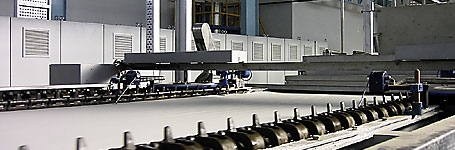
Stenters are widely used for stretching, drying, heat-setting and finishing of Fabrics. The stenter frame is usually 80-100 feet long and 70-100 inches wide. The speed ranges from 10-45 m/min with a maximum setting time in the setting zone 30 sec at temperature ranging from 175 to 250~ depending upon the thickness and type of the material. 


 Iodine absorption test:

Heat set polyester absorb less iodine than the corresponding unheated material and this property is used for assessing the degree of heat setting of polyester. To do this test following is the procedure:

Take 1 grm of sample accurately weighed into a 250 ml stoppered flask and 30 ml of 0.1 N iodine solution (Prepared by dissolving 12.7 g iodine and 20 g potassium iodide in water. To this solution is added 100 ml of glacial acetic acid and 350 ml phenol (measured at 60oC and finally diluted to 1 litre with water) is added and allowed to stand for at least 2 hours. After this period, the specimen is transferred to a sintered glass crucible (G1) and washed with water till free from iodine. The sample is then transferred to a 250 ml flask containing 50 ml chloroform. As the chloroform is powerful swelling agent for polyester, the iodine absorbed by the polyester quickly passed from the fibre to the chloroform. Exactly 10 ml of 0.1 N sodium thiosulphate is added and the mixture is titrated against 0.01 N iodine solution, using starch as indicator. Simultaneously a blank determination (without sample) is carried out under the same conditions. The absorbency of iodine is expressed in mg of iodine per gram of fibre i.e

Iodine absorption (mg/g)= {(X-Y) X 0.01 X 127}/ W

Where, X=ml of 0.01 N iodine required for blank
Y= ml of 0.01 N iodine required for sample
W=Weight in g of sample
If the polyester is blended with cellulose then later portion should be removed by carbonization (dissolving in sulphuric acid) and only polyester portion is taken for the above test.

Also note that the there is a significant effect of temperature on iodine absorption by polyester. With increase of temperature the iodine absorption value also increases. It is therefore necessary to carry out the test at the same temperature, in order to get reproducibility of the results.

Saturday, 18 October 2014

2. Chain Mercerizer:
In order to make up for the shortcomings of the roller mercerizing machine, a clip stenter is used for post-mercerization treatment, in which a widthwise tension is applied then most alkali is showered off the fabric kept on the stenter, followed by thorough alkali removal and neutralization using an open-width washing machine.In this machine a heavy padding mangle is used for the application of alkaline solution in the 2 dip/2 nip method, with sufficient time allowed for penetration and swelling of the fabric in a timing cylinder, instead of undergoing an operation using so many rollers and so much solution as in roller mercerization, to ensure reduced use of the alkali. 

It is to be noted that all the fabric mercerizing process involve 4 steps:

i) Impregnation with caustic soda solution
ii) Stabilisation (first rinsing stage under tension)
iii) Washing in open width washing range
iv) Neutralising 

Recipe for mercerizing fabric:

Caustic soda: 20-23% (48-52 oTw) or (28-30 oBe)
Temperature: approx 20oC
Time: 30-45 seconds


Machine Feature:

In a chain mercerizer, the cotton fabric is padded with two number of 3 bowl padding mangle, the troughs of which containing the required concentration of caustic soda and wetting agent. Between the two impregnation, the fabric goes around a set of dummy rolls (for timing and swelling), which are driven by fabric movement. The two squeezing nips of the padding mangle run at different speeds, the second one running fastest than the first one, in order to maintain the required tension in the warp way. 

After impregnation, the fabric is fed into the clips of a stenter, where it is stretched in the weft direction to the required dimensions. The alkali in the fabric is rinsed out with sprays situated over the stenter, initially with hot water and then with cold water. Thoroughly and even washing out to the order of less than 60 gpl of caustic soda remaining in the fabric. Until then the tension should not be released. Then the fabric is washed thoroughly in an open width washing range and neutralised. Here a counter current washing system is employed, wherein fresh water is introduced at the delivery end of the machine and the first wash liquor that the cloth meets in the stenter is slightly alkali concentration. 


Friday, 17 October 2014

2. Chain Mercerizer:
In order to make up for the shortcomings of the roller mercerizing machine, a clip stenter is used for post-mercerization treatment, in which a width wise tension is applied then most alkali is showered off the fabric kept on the stenter, followed by thorough alkali removal and neutralization using an open-width washing machine.In this machine a heavy padding mangle is used for the application of alkaline solution in the 2 dip/2 nip method, with sufficient time allowed for penetration and swelling of the fabric in a timing cylinder, instead of undergoing an operation using so many rollers and so much solution as in roller mercerization, to ensure reduced use of the alkali. 

It is to be noted that all the fabric mercerizing process involve 4 steps:

i) Impregnation with caustic soda solution
ii) Stabilisation (first rinsing stage under tension)
iii) Washing in open width washing range
iv) Neutralising 

Recipe for mercerizing fabric:

Caustic soda: 20-23% (48-52 oTw) or (28-30 oBe)
Temperature: approx 20oC
Time: 30-45 seconds


Machine Feature:

In a chain mercerizer, the cotton fabric is padded with two number of 3 bowl padding mangle, the troughs of which containing the required concentration of caustic soda and wetting agent. Between the two impregnation, the fabric goes around a set of dummy rolls (for timing and swelling), which are driven by fabric movement. The two squeezing nips of the padding mangle run at different speeds, the second one running fastest than the first one, in order to maintain the required tension in the warp way. 

After impregnation, the fabric is fed into the clips of a stenter, where it is strtched in the weft direction to the required dimensions. The alkali in the fabric is rinsed out with sprays situated over the stenter, initially with hot water and then with cold water. Thoroughly and even washing out to the order of less than 60 gpl of caustic soda remaining in the fabric. Until then the tension should not be released. Then the fabric is washed thoroughly in an open width washing range and neutralised. Here a counter current washing system is employed, wherein fresh water is introduced at the delivery end of the machine and the first wash liquor that the cloth meets in the stenter is slightly alkali concentration.